
When Does a Shopify Store Actually Need Custom Development?
Every so often someone comes to me with a feature request and opens with "we probably need custom development for this." Sometimes they're right. Often they're not, and the more interesting part of the conversation is figuring out which one it is before anyone writes a line of code.
Custom development shouldn't be the reflexive starting point for a new requirement, even though it can sometimes be the obvious answer once you actually understand what the business needs. Shopify's native functionality, a well-built theme, and a handful of well-chosen apps solve a genuinely large share of what a store actually needs to do. The bar for "we need something custom" should be higher than most conversations treat it.
That doesn't mean custom development is something to avoid. It means it's something to earn.
Start with the simplest thing that works
Good engineering has never meant writing code whenever the option is available. It means picking the solution that reliably does the job with the least amount of stuff that can break, that needs maintaining, or that someone has to understand six months from now.
Shopify's platform covers more ground than people assume. Metafields are excellent for structured data attached to products, customers, or the store itself, but they're not a real substitute for a proper data model once relationships, workflows, or operational state start getting complex. Markets handles multi-currency and localization in a way that used to require a lot of custom logic.
Shopify Functions and Flow both help here, but they solve different problems. Functions extend specific backend behavior, like custom discount logic, delivery and payment customization, or checkout validation. Flow is more about event-driven automation: triggering actions when an order, customer, or inventory event happens. Between the two, a surprising amount of business logic can be expressed without a custom backend.
Sections and blocks give merchandising teams real control over layout without touching code. The app ecosystem exists precisely because most stores hit the same handful of problems: reviews, subscriptions, loyalty, upsells, inventory sync.
If a native feature or a good app gets you most of the way to what you need, reliably, building the whole thing from scratch is usually not smart spending. It isn't more serious or more professional. It's often just more expensive and more fragile, for no real benefit.
Where the standard model stops fitting
Custom development starts to make sense when the business doesn't run on the process Shopify was designed around, not just when something is mildly inconvenient.
A few patterns show up repeatedly. Booking or capacity-based products, where inventory isn't a simple count but depends on dates, time slots, or resource availability. Complex product configuration, where the customer is assembling something out of interdependent options rather than picking variants from a fixed grid. B2B workflows that outgrow what Shopify's native B2B tools already cover, especially on Plus, where company accounts, negotiated pricing, and purchase orders are handled reasonably well out of the box, but unusual approval chains or procurement rules specific to one business often aren't. Pricing logic that depends on customer segment, quantity breaks, or contract terms that don't map onto Shopify's standard discount model. Bundles or bill-of-materials style products, where one SKU the customer buys actually needs to deduct stock from several underlying components. Operational workflows, like a fulfillment sequence or a compliance step, that the business genuinely needs and that Shopify never had in mind.
None of these are exotic. They're common in real businesses, and what they tend to have in common is that the business logic itself becomes the thing you need to model, not just the storefront sitting on top of it. That's usually the point where bending Shopify's default model into the right shape starts costing more than it saves.
When "just install another app" stops working
Apps are one of the best things about this platform, not a compromise. A well-chosen app is usually cheaper, faster, and safer than custom code, because someone else is maintaining it, patching it, and keeping it compatible with Shopify's changes.
The problem isn't apps. It's when several apps are stacked to approximate a single business process, each one storing its own slice of the data and making its own assumptions about how the others behave. A subscription app that doesn't quite agree with a bundling app about what a "unit" is. An inventory app and a booking app that both think they own the source of truth for stock. A pricing app layered on top of another pricing app because the first one couldn't handle one specific case.
Each individual app is fine on its own. The stack as a whole can become increasingly difficult to reason about, and every new app added to patch the last app's limitation adds another point where the pieces can quietly disagree with each other. At that point complexity is going up, not down. That's usually the moment worth stepping back and asking whether one purpose-built piece would actually be simpler than five general-purpose ones bolted together.
Integrations are often where custom work becomes more likely
ERP systems, warehouse and fulfillment platforms, supplier or product data APIs, external inventory, a CRM, a booking or ticketing system that lives outside Shopify entirely: these are the systems most likely to eventually need custom work. That's not the same as saying they always do. Many of them already have solid, well-maintained connectors, and a good one can genuinely be the right answer. Custom integration work tends to become relevant once the way two specific systems need to interact doesn't quite match what any existing connector was built for.
Writing the API call is the easy part. Almost anyone can send a request and parse a response. The actual engineering problem is everything around it.
Who owns which piece of data when two systems disagree. What happens when a webhook fires twice, and whether the system is built so that replaying the same event by accident is harmless rather than something that quietly duplicates an order or double-deducts stock (developers call this property idempotency). What happens when a webhook doesn't fire at all. How a partial failure halfway through an order sync gets handled, how conflicting updates get resolved, and how you avoid quietly corrupting stock numbers because two systems updated the same SKU thirty seconds apart.
That's not a criticism of apps that handle integrations. Plenty of them do this well for common cases. But once a business has integration requirements specific to how it actually operates, someone has to design that reliability layer deliberately. That design work is real custom development, even when very little of it looks like writing a new feature.
When a workaround becomes a business risk
A scrappy workaround is often the right call. If something fails occasionally and the consequence is a minor inconvenience someone fixes manually, that's a reasonable trade-off, especially early on.
It stops being reasonable once a failure means the wrong price gets charged, an item sells that isn't actually in stock, an order gets lost between two systems, customer data goes out of sync, checkout breaks for a segment of customers, or an operational process quietly falls apart because nobody's watching the automation that was holding it together. At that point the real cost of the workaround isn't the time it takes to maintain. It's the risk sitting behind it, and risk tends to be a lot more expensive than most people price it at upfront.
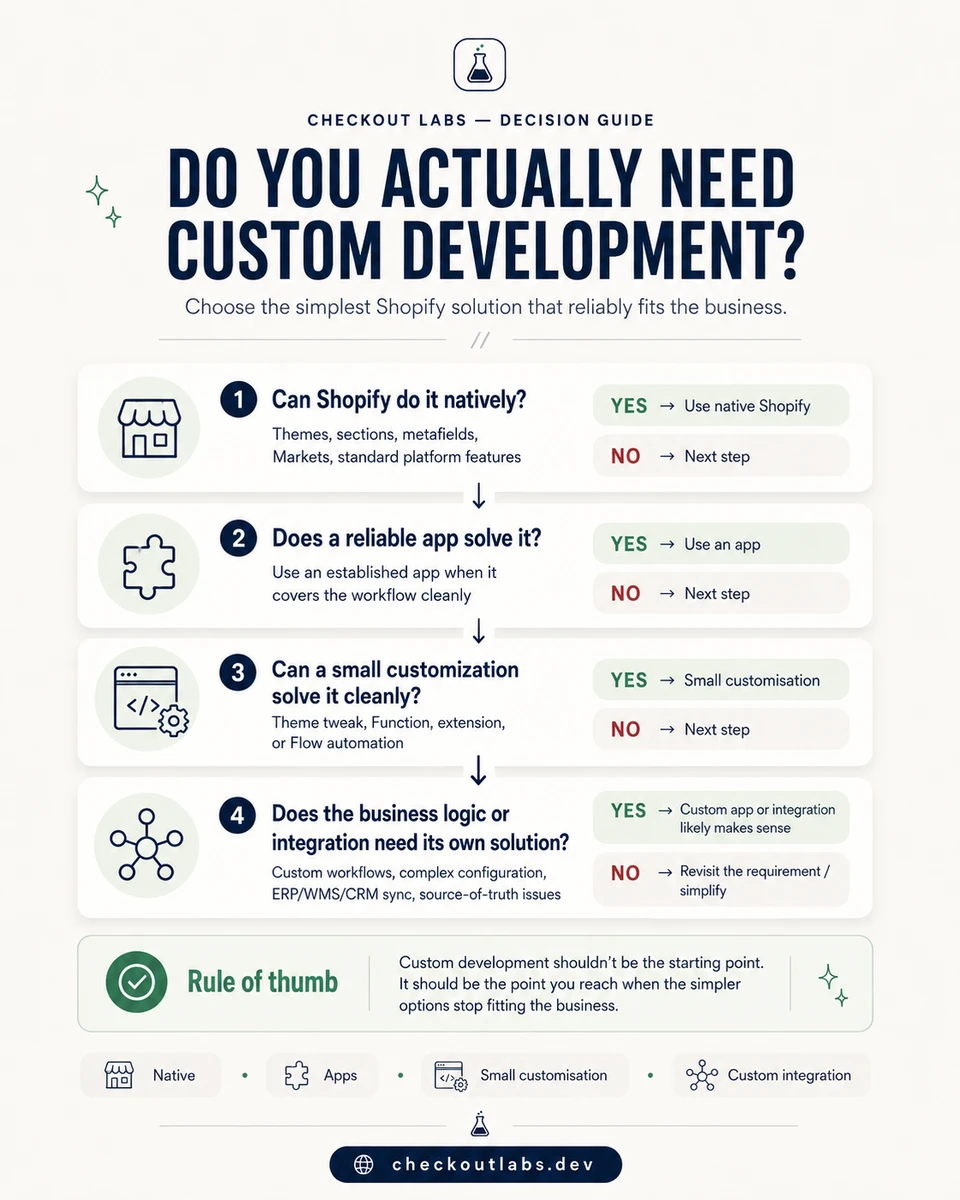
The real question
It helps to think about this less as a rigid technical hierarchy and more as a short sequence of questions, since each option is really suited to a different kind of problem. Can Shopify already do this natively? Is there a reliable existing app that solves it? Is a small theme or platform-level extension enough? Does the underlying business logic actually require a custom app or integration? A more specialized architecture should only enter the conversation once those simpler options clearly stop fitting. Working through it in that order doesn't guarantee the cheapest answer every time, but it's a reasonable way to rule out the simpler options before reaching for the most expensive one.
The question worth asking isn't "should we build this custom or not." It's simpler than that: what's the least complicated solution that reliably supports how the business actually works, without quietly creating more problems a year from now.
If an off-the-shelf option solves the problem reliably, building it from scratch is usually a waste of money. If the business keeps having to fight the platform to do something it needs to do regularly, that's usually a sign the simpler options have been exhausted, and building the right thing is what actually saves money going forward.
Most of the time, the answer isn't as dramatic as either extreme. It's a matter of paying attention to which side of that line the business is actually on.