
Your Shopify Store Probably Doesn't Need Another App
A merchant needs a feature. There's an app for it, so they install it. A few months later another requirement shows up, and there's an app for that too. Then one app doesn't quite talk to the other, so someone adds a Flow, a tag, a metafield, a small script, or a third app whose whole job is to bridge the first two. None of these decisions looks unreasonable in the moment. Each one solves a real problem, quickly, for a reasonable price. A year later, one ordinary business process, something like "a customer buys a bundle with a subscription option," depends on five tools that nobody ever sat down and designed to work together.
That's not a story about a badly run store. It's just what happens by default when "install another app" becomes the standard answer to every new requirement, without anyone occasionally asking what the whole system looks like now.
The point of this isn't that Shopify apps are a problem. Most of the time they're the right call, and I'll get to that. The point is narrower: an app should remove complexity from your store, not just move it somewhere harder to see.
Apps are usually the right answer
This is worth saying plainly, because it's easy to slide from "watch out for app sprawl" into "apps are bad," and that's not the argument.
A mature, well-maintained app comes with years of development and edge-case handling you didn't have to pay for directly. It stays compatible with Shopify's API as the platform changes. It gets patched when something breaks. There's usually someone to ask when it doesn't behave. Rebuilding subscriptions, reviews, loyalty, search, or email marketing from scratch is rarely good engineering and almost never good economics, because you'd be paying to reinvent something a specialist team has already spent years hardening. If a reliable app solves a standard problem cleanly, installing it is usually the sensible move, and nothing in this article is an argument against doing that.
The number of apps was never the problem
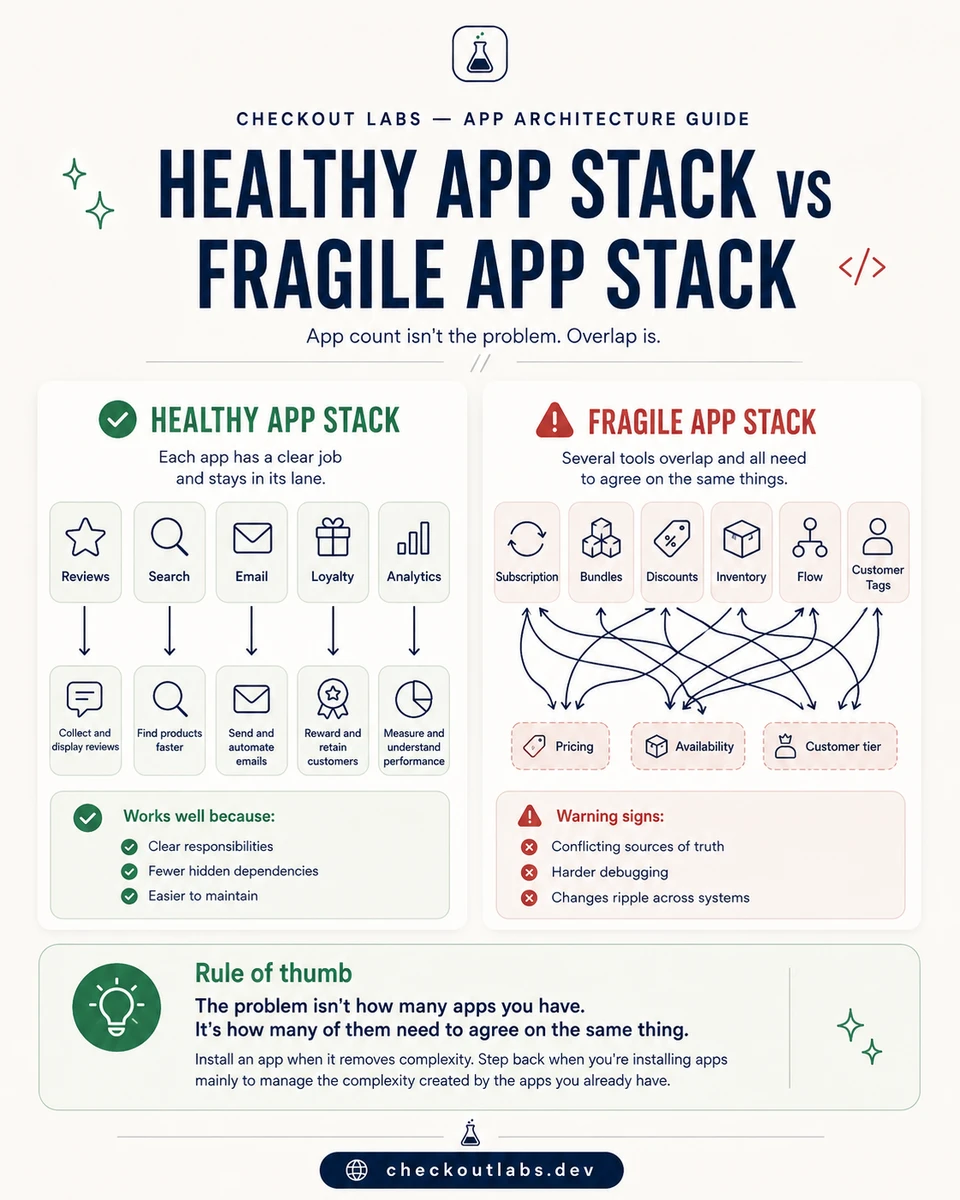
"You have too many apps" is usually too simple a diagnosis. Ten independent apps, each doing one clearly scoped thing, can be a perfectly healthy setup. Three apps that all touch cart state, pricing, inventory, and customer tags at the same time can be a mess even though the number is smaller.
The question worth asking isn't how many apps a store has installed. It's how many different systems need to agree with each other before a customer can place an order correctly. A store can run thirty apps and have a clean architecture, as long as each one owns something specific and stays out of everyone else's way. A store can run five and be fragile, if all five quietly assume they're the one in charge of the same piece of the business.
Where it actually gets messy
The pattern usually isn't one bad decision. It's several fine decisions that end up overlapping.
A subscription app, a bundling app, and a discount app all need to agree on what the customer is actually buying, and they don't always define "one unit" the same way. A booking app and Shopify's own inventory both try to represent availability, and neither one is wrong exactly, they're just both authoritative about the same thing. A loyalty app updates customer tags that a Flow automation and a custom pricing rule also read from, so a change meant for loyalty tier quietly shifts pricing somewhere else. Two or three apps inject their own JavaScript into the same product or cart experience, each reasonable on its own, together occasionally fighting over the same DOM element. One app generates data that another app depends on, so the second app's reliability is really the first app's reliability, whether anyone wrote that down or not. And sometimes a second app gets installed mainly to work around a limitation in the first one, which is a sign worth noticing in the moment rather than a year later.
Individually, every one of these is a reasonable choice given what the person making it knew at the time. Combined, they can add up to a system that becomes increasingly difficult for anyone to reason about as a whole.
Who owns what
This is the part worth being deliberate about, because it's rarely designed on purpose, it just accumulates.
Who owns inventory: Shopify, the warehouse system, the booking app, or the ERP? Who owns customer tier: the loyalty app, a customer tag, or a CRM? Who owns pricing: Shopify itself, a B2B app, a discount Function, or something external? Different kinds of data don't need to live in the same system. Inventory might reasonably be owned by an ERP while customer data is owned by Shopify or a CRM. What matters is that for each important concept, there's one clear authoritative source and a predictable way everything else stays in sync with it. When two systems both believe they own the same concept, the edge cases (a return, a partial fulfillment, a mid-cycle plan change) are where that ambiguity turns into a real bug.
The same accumulation shows up as hidden dependencies. Someone removes an app and something unrelated breaks. A metafield gets renamed and an automation nobody remembered existed quietly stops firing. A theme snippet expects an attribute that only exists because of an app that was uninstalled eight months ago. A Flow depends on tags that a different app used to create. A team disables an app to save on the monthly bill and only realizes later that it was actually part of how something important worked. None of this shows up in a demo. It shows up the first time someone touches the system without knowing everything that's actually connected to it. If nobody in the business can explain what breaks when a given app is removed, that's a warning sign worth taking seriously, independent of how well any individual app works.
What it actually costs
It's worth resisting the old reflex of "every app slows your store down." Plenty of modern apps have no meaningful storefront footprint at all. The ones that do affect performance tend to be the ones injecting scripts, pixels, widgets, or DOM changes into the customer-facing experience, and that's worth measuring directly rather than assuming from the app count.
The subscription cost is real but usually not the main cost. Ten apps at twenty dollars a month can still be far cheaper than maintaining equivalent custom software. The larger cost shows up as operational complexity: the time spent debugging an issue that touches three vendors, onboarding a new developer who has to learn which of five tools actually owns a given piece of data, testing a change carefully because it might ripple through integrations nobody fully mapped, and the slow accumulation of manual reconciliation between systems that were each installed to save time.
When to step back instead
None of this means fewer apps is automatically better, or that the next step should be custom development. It means occasionally stepping back and asking whether the system as a whole still makes sense.
A few signs are worth paying attention to. Two or more systems believe they own the same data. New apps keep getting installed mainly to compensate for another app's limitation rather than to add something new. One ordinary business process spans a handful of unrelated tools that were never meant to work together. Nobody can say with confidence what would break if a given app were switched off.
A simple-sounding change now requires testing several integrations instead of one. App limitations have started quietly dictating how the business operates, instead of the other way around. The team is regularly doing by hand what should be automatic, reconciling numbers between two systems that are each convinced they're right.
When that's the situation, the right move isn't automatically custom software. Sometimes it's replacing three overlapping apps with one better one. Sometimes it's simplifying the business process itself rather than the tooling. Sometimes it's removing a feature nobody actually needed. Sometimes it's a native Shopify feature that quietly does what three apps were approximating. Occasionally it really is a small, purpose-built integration or a custom app, but that's one option on the list, not the default conclusion.
The goal was never to minimize how many apps a store runs. It's to minimize the complexity nobody's actually managing. A store with thirty apps can be healthy. A store with five can be fragile. Install an app when it removes complexity. Step back when you notice you're installing apps mainly to manage the complexity created by the apps you already have.